
A Step-by-Step Journey from Sound Awareness to Confident, Joyful Reading
If you’re new to Montessori education, you might be surprised to discover that reading doesn’t start with books! At International Montessori in Austin, we follow a carefully designed progression that begins with listening, moves into writing, and naturally leads to fluent, enthusiastic reading. Our approach is multi-sensory, child-led, and built on the belief that children are eager to unlock language—when the time is right for them.
In this post, we’ll guide you through how we teach reading in our classrooms, highlight the key materials we use, and explain why this method fosters a lifelong love of language.
It All Starts with Listening
Long before a child decodes their first word, we build a strong foundation in spoken language. Through storytelling, songs, rhymes, conversations, and daily narration, children absorb rich vocabulary, rhythm, and sound patterns.
Our classrooms buzz with oral language opportunities. Children describe their work, listen thoughtfully, and engage in meaningful discussions. This “pre-literacy” phase is active and immersive, tuning young ears to the sounds and structures of language.
Writing Comes Before Reading: A Signature Montessori Approach
One of the most unique aspects of Montessori language instruction is that children begin “writing” before they read. It might seem backwards, but there’s deep wisdom behind it!
Writing (or encoding) is easier for young minds because children already know what they want to express. Reading (decoding) requires interpreting unfamiliar symbols and attaching meaning— a more complex step.We introduce letter sounds through tactile sandpaper letters. Children trace the textured shapes while saying the phonetic sound (not the letter name), engaging touch, sight, and hearing for lasting brain connections.
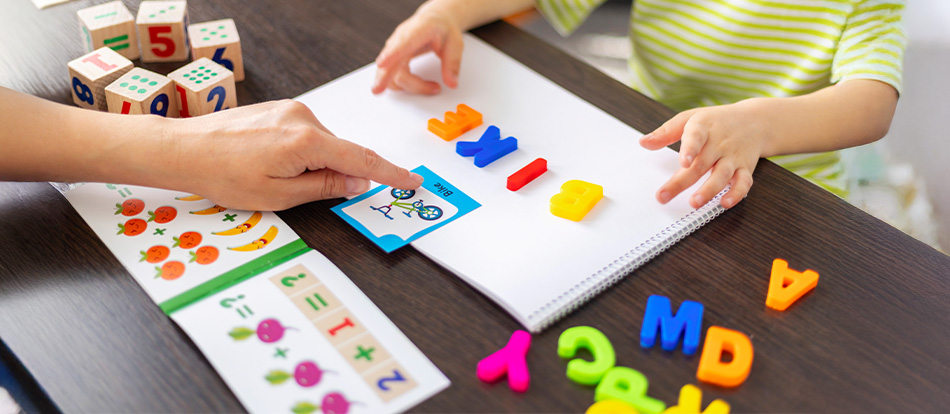
Once familiar with sounds, children use the movable alphabet to build words like “cat,” “sun,” or “dog.” This marks the exciting start of writing—without the pressure of perfect handwriting!

Building Phonemic Awareness Through Playful Sound Games
These early activities develop phonemic awareness—the ability to hear and play with individual sounds in words, a crucial skill backed by reading science.
Our guides lead fun sound games: “What sound starts ‘bat’?” or “What rhymes with ‘hop’?” These joyful interactions help children master language’s building blocks.
The Magical Moment When Reading “Clicks”
The shift to reading often happens spontaneously. After plenty of writing practice, children recognize their own spelled words and eagerly decode others.
We watch each child’s readiness closely, introducing materials only when they’re prepared. This keeps reading pressure-free and full of delight!
Children then explore simple phonetic booklets, labels, and three-letter words with short vowels. Gradually, they advance to phonograms (like “sh” or “ee”), silent “e” rules, and sight words—all supported by hands-on activities.

Key Montessori Materials That Make Reading Tangible
Our classrooms feature beautiful, intentional materials to bring reading to life:
- Phonetic Object Boxes: Miniature objects (like a tiny cup for “c-u-p”) that encourage sound blending.
- Pink, Blue, and Green Series: Color-coded reading sets that progress from simple phonetic words to complex patterns.
- Classified Cards and Booklets: Picture-word matching and simple readers that build vocabulary, fluency, and comprehension.
What Sets Montessori Reading Apart
Unlike many traditional programs that start with letter names and sight-word memorization (treating reading as visual matching), Montessori emphasizes a phonetic, decoding foundation.
We teach sounds first (“b” as /b/) before names (“bee”), aligning with how children naturally process language.
At International Montessori, this proven approach helps children become confident, independent readers who truly love books. If you’d like to see it in action, we’d be thrilled to welcome you for a tour at one of our Austin campuses!
Ready to learn more? Contact us today to schedule a visit.